


There is a sentence that I’ve been saying for about a decade now.
It’s true, but in many ways, it oversimplifies the truth.
I’m a law professor.
I say it at conferences, at dinner parties, at my son’s school to curious teachers, on airplanes to nosy strangers. I say it to explain the trips to random cities for academic presentations, the stack of unfinished books in my tote bag, the way anxiety builds in my spirit every August when a new school year is on the horizon.
People hear the declaration and decide, within seconds, how they will categorize my work, my potential, my contribution. They decide who I am and what box to place me in.
But there are aspects of me that do not fit neatly within that sentence.
I write poetry, short stories, and essays that aren’t technically scholarship. I write scholarship that routinely breaks the traditional academic mold. And I have done both for a long time, often in the shadows.
These creative projects emerge in the margins of my so-called “real work.” During odd hours, inside tattered Moleskine journals, across yellow legal pads that I don’t show to anyone. For most of my academic career, I have treated my creative writing the same way one might treat a habit they are ashamed of.
Something I do when I should be doing real work. Something I do to pass the time when I am bored. Something I do for fun. Something to hide or discount or downplay because it’s not that serious, right?
I used to think the problem was time.
Academics always think the problem is time. Give me a sabbatical, give me a free summer, give me a course release, give me tenure, and just watch. I will finally get it all done.
But I’ve had those.
And I now understand that it has nothing to do with time.
What I’m doing
Starting this month, September 2026, I’m going to spend an entire academic year working through a creativity program in public, in this newsletter, and I’m inviting you to do it with me.
The program is from Julia Cameron’s acclaimed and bestselling book, The Artist’s Way, a book that’s been in print since 1992 and has been praised by creatives ever since. The program in that book, described as a spiritual path toward higher creativity, is twelve weeks long. But I am going to do something slightly different.
I’m going to take eight months and work my way through it a bit slower. Principally because I teach, and because you teach, and because a twelve-week sprint that begins in September is a promise that neither of us can keep.
But I’m not just going to share my thoughts on the journey.
Alongside reading each chapter slowly on a two-week cadence, I’m also reading something short from the Black literary tradition — an essay, a story, a speech — by people who thought hard about what it costs to make something authentic and true to you when the world has already decided what you’re good for.
They will be selections from Audre Lorde, Zora Neale Hurston, Langston Hughes, Octavia Butler, James Baldwin, Toni Morrison, and others. A total of twelve pieces across the academic year, none of them too long to be finished in two weeks.
I want these works to be in conversation with The Artist’s Way because I am curious what that discourse will produce in me, as a legal scholar, and in others too.
Why here, and not somewhere else
Cameron’s premise in The Artist’s Way is that most of us are blocked by an inner critic—she calls it a censor—who we’ve internalized. We can dismantle this critic and its limiting beliefs by giving ourselves permission and engaging in ongoing play. For a lot of readers and shadow artists, I imagine that’s more than enough.
But I don’t think it’s enough for everyone.
The censor in an academic’s head is different. It speaks in the voice of a reader you can’t see but could very well know more than you about what you are writing. It knows all about placement rankings, tenure standards, the topics your subfield thinks are central and the ones it thinks are minor or peripheral.
These beliefs are not imaginary.
They are backed by institutions that evaluate you continuously and hold your livelihood in their hands. When you tell an academic that their inner critic is made up, they will likely nod politely and smile because they are nice people, after all, but they will also likely think, quietly: my inner critic has a committee.
In other words, imposter syndrome isn’t some private neurosis we talk ourselves out of. It’s what any rational person feels inside a system built to judge them. This means the fix isn’t merely giving yourself more permission.
The fix, in my view, is something closer to what the writers in the Black literary tradition were after—a way to keep producing meaningful work when the limits are real and the resistance isn’t going away any time soon.
What I actually believe
There are three beliefs driving this series:
Scholarship is creative work.
Most of us came into this profession because academia felt like a calling. A life spent thinking, teaching, and serving. Making arguments that others have been too afraid to make. Putting ideas into the world and boldly standing behind them.
It sounds very much like an artistic vocation clothed in institutional language. But somewhere between the job talk and the third-year review, too many of us stop feeling like creatives and start regurgitating the same ideas.
Cutting against the grain isn’t a distraction from scholarship.
The pressure to write the safe piece, or join the safe conversation, or make the expected moves plagues every academic, especially in the early years on the tenure track. It is also the same pressure many artists feel to produce work that will sell versus work that is true to their artistic vision. Refusing that pressure is not a departure from serious scholarship. It is what serious scholarship was always supposed to be—innovative and groundbreaking.
Academia already requires original work.
Every tenure file demands an original contribution. Academia has been asking us for creative work all along. We simply have never called it art.
I believe a lot of us are already artists, but have simply been trained out of noticing our raw talent and innovative ideas.
How this creative program works
This creative program will follow two practices:
Three pages of free writing, every morning.
Every day, before the grind of academic life begins, spend a few quiet moments alone and write whatever comes to your mind until you fill up three pages. Nobody should read them, including yourself, at least initially.
Complete one short reading every two weeks.
These short readings from the Black literary tradition—essays, short stories, speeches—are paired with a chapter from The Artist’s Way. Many of them are available free online and I will include links to them for your convenience.
Of course, you will need Cameron’s book, The Artist’s Way, which carries the weekly exercises and chapters guiding this practice.
Everything else will be shared here, every other Saturday.
The syllabus
This is the syllabus I will be following:
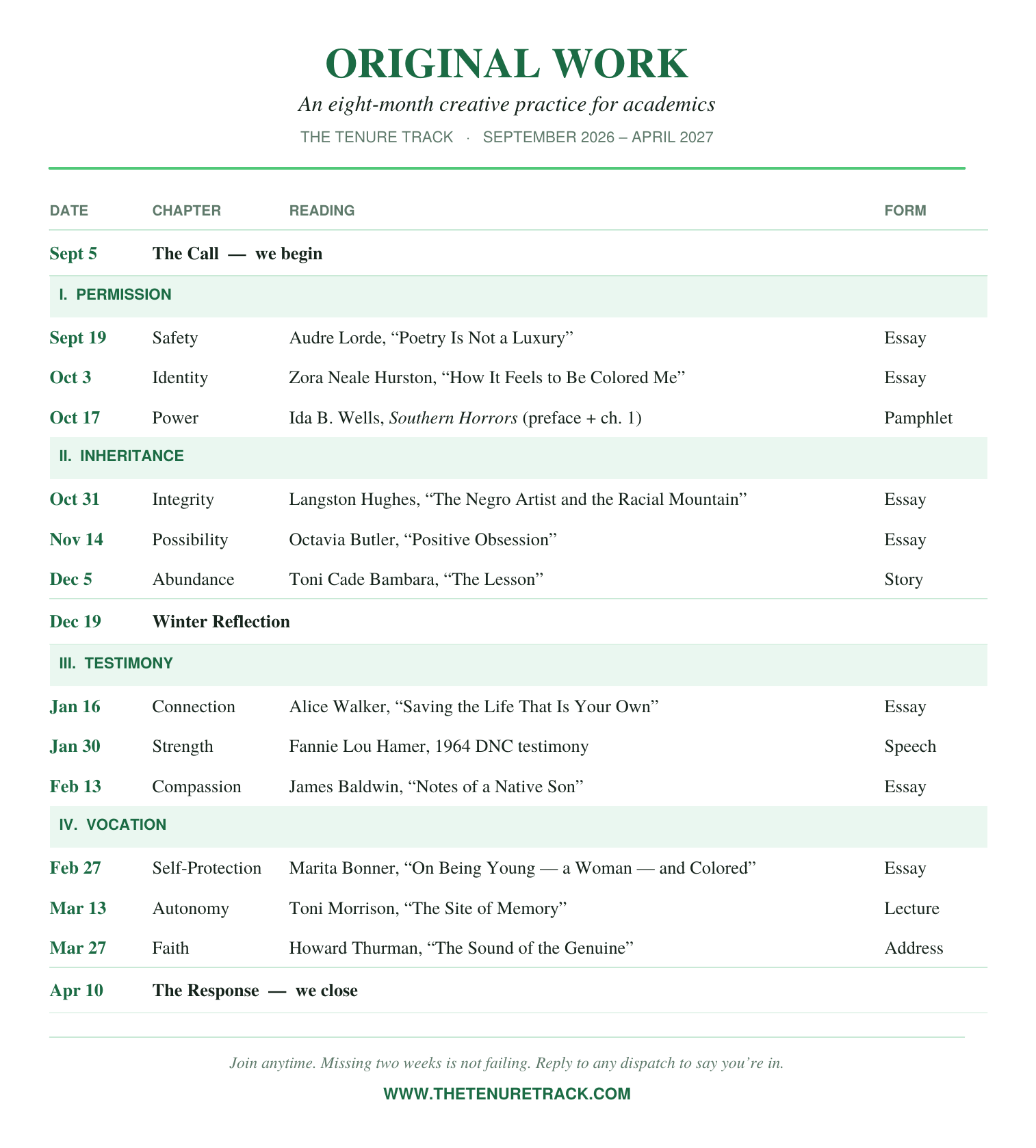
Here is a one-page version you can download.
Join me on this journey
I don’t know how this ends.
I’m not going to tell you in April that I have found myself, because I don’t know that I will. That essay has been written enough times, and more often than not, it’s not actually true.
What I can promise is that I’ll tell you the truth about what I am learning, including the weeks when it doesn’t feel like anything is working.
This will not be an open diary.
But I will share a bit about the writing process and the revelations I encounter as I navigate them.
This first dispatch is called The Call because in the tradition I write from, nothing truly happens until someone answers because everything we do is part of a larger conversation. The last one, in April, will be called The Response.
Reply to this email if you’re in, or comment below.
You can join in October, or February, or anytime you wish. You can miss two weeks and pick it back up without apology.
If you are here at the beginning, get a copy of The Artist’s Way, and read Audre Lorde’s short essay, Poetry Is Not a Luxury.
See you in two weeks.
Becoming Full,

P.S. As always, thank you for reading this week’s issue of The Tenure Track. If you found this article helpful, share it with a friend. If it moved you, consider supporting with a paid subscription or buying me a coffee. Together, let’s continue to build a supportive and creative academic community.
Your support helps me create content that serves fellow scholars on the path.
This sounds awesome Prof! I am going to try my best to stay on point!
I'm a professor who explored The Artist's Way (TAW) for the reasons you mentioned. I realized that scholarly work is an outlet for my creativity, and I wanted to more intentionally nurture my creative self. I've attempted TAW twice, but have read the book in its entirety. Although the rich white women privilege and religious undertones were a bit grating, I got a lot out of engaging with her ideas. Morning pages have been transformational for me.
I look forward to following your journey! While I won't be re-reading TAW, I really appreciate your addition of Black creatives to the curriculum and will be reading their works!