

It was 11:47 PM on a Sunday night, and I was still grading Contracts exams.
Seventy-three of them, to be exact.
They had been sitting on my desk all weekend, and I had become very good at avoiding them. My eyes burned from staring at my laptop. My coffee had gone cold hours earlier. My back was beginning to question my commitment to the office chair.
The bigger problem was that I had a class the next morning and I still needed to finish preparing my PowerPoint slides.
But in my mind, this was not a crisis.
In fact, by that point in my career as a law professor, moments like this had started to feel normal, almost to be expected. Academic life had become a constant negotiation between competing responsibilities: writing deadlines, grading, student meetings, committee obligations, conferences, and the steady stream of opportunities that arrive once people begin to recognize your work.
I convinced myself this was simply what success looked like.
You work hard. You say yes. You push through busy seasons. Then, eventually, things slow down.
Except things rarely slowed down.
I had started to mistake exhaustion for commitment. I treated being overwhelmed as evidence that I was doing meaningful work. The more responsibilities I carried, the more accomplished I felt.
And the irony was not lost on me. Much of my scholarship about the law examines how institutions shape individual and collective behavior. I write about how legal systems create incentives, distribute burdens, and influence the choices people make. I teach Contracts, where students learn that the structure of an agreement matters because it shapes what happens later when circumstances change.
Good systems anticipate problems.
They do not simply respond after things fall apart.
Yet I was managing my own professional life as a series of emergencies. I was constantly responding to whatever felt most urgent in the moment rather than intentionally deciding what deserved my full attention. Nothing was completely broken. But something was clearly not working.
The realization came slowly. It was not one dramatic moment where everything collapsed. Instead, it was the accumulation of small signs that my approach was unsustainable and my inbox was becoming unmanageable.
I started forgetting deadlines that mattered.
I would remember a project but forget the next step. I would have conversations about ideas I wanted to pursue but struggle to move those ideas into actual writing. I found myself increasingly stressed. Not because I was failing, but because I was carrying too much in my head with too little to show for it.
The problem was not that I had too much ambition.
The problem was that I had no reliable system for managing my creativity.
The Problem Wasn’t Discipline
For a long time, I assumed the answer was simple:
I need more discipline.
I read books on productivity and flow and time management.
Maybe I needed a better routine. Maybe I needed to become more efficient. Maybe I needed to find the perfect productivity system that would allow me to finally stay ahead.
But the more I paid attention to my own experience—and the experiences of colleagues I admired—the more I realized that discipline was not the issue.
The academics who struggle with overload are rarely people who lack motivation. They are some of the most committed people I know. They care deeply about their students, their scholarship, their institutions, and their communities.
The challenge is that academic careers become more and more complex over time.
Yet we receive very little training on how to manage that kind of complexity.
Early in an academic career, the challenge is scarcity. You are searching for ideas, searching for opportunities, and searching for recognition. Every conference acceptance matters. Every publication matters. Every revise-and-resubmit matters.
But then something changes.
The ideas begin arriving faster than you can pursue them. Invitations start appearing out of thin air. Collaborations develop organically. Every conversation produces another possible article, another possible project, another possible opportunity.
What once felt like momentum can begin to feel like too much.
At one point, I realized I had multiple writing projects in various stages of completion. Some were nearly finished. Others were just ideas. A few had become permanent residents of a folder on my computer desktop I kept telling myself I would return to “next summer.”
The problem was not a lack of ideas.
The problem was deciding which ideas deserved my limited time and energy.
The same was true for professional opportunities.
I remember agreeing to participate on a panel because it was a great opportunity with wonderful people I admired. There was nothing wrong with saying yes. It was exactly the kind of invitation that academics are encouraged to accept.
But months later, as the event approached, I began to regret the decision. It wasn’t because the panel was unimportant. It was because I had never developed a process for asking whether every good opportunity was actually aligned with the work I was trying to build. I did not know how to say “no.”
Academic culture teaches us how to produce.
It does not teach us how to choose.
Building a More Sustainable Practice
Once I recognized that the problem was structural rather than personal, I started experimenting with different ways of working.
I began paying closer attention to scholars whose careers I admired—not just those who produced a lot, but those who seemed able to sustain meaningful work over time without constantly appearing overwhelmed.
What I noticed was that they were not necessarily working more hours.
They had systems.
They had unique ways of organizing their ideas, protecting their time, and making decisions before every new opportunity became an emergency they had to survive.
So I started building my own.
The first change was creating a writing pipeline. Instead of keeping every project in my head, I created a system where each project had a clear stage and a clear next step. A half-finished idea no longer had to compete with a nearly completed article for my time and attention.
The second change was developing a project portfolio. Academics often think about individual projects, but careers are built from the interaction of many projects happening at once. I needed a way to see whether my commitments actually reflected my priorities, and identify how they fit into my scholarly agenda.
The third change was creating a decision process for opportunities. I wanted a way to evaluate invitations before automatically saying yes. A script or approach that allowed me to confidently say no when necessary.
None of these changes transformed my life overnight.
And that is actually the point.
My schedule did not suddenly become empty. I still had teaching responsibilities. I still had meetings. I still had emails. I still had deadlines. I still had new ideas. I still had students busting into my office unannounced.
But I stopped carrying everything alone in my head.
The anxiety began to decrease because I had a clearer understanding of what mattered now, what could wait, and what I needed to decline.
The work remained demanding.
I just became more intentional with how I navigated it.
Why I Built the Sustainable Scholar System
I share this because I know the temptation to look at someone’s accomplishments and assume they have figured everything out, or they are an exception to the rule.
I have published more than twenty legal articles and essays in roughly 9 years in the legal academy, including work appearing in journals such as the Columbia Law Review, NYU Law Review, Virginia Law Review, California Law Review, UCLA Law Review, and Georgetown Law Journal. Earlier this year, I received the USC Educational Foundation Research Award for Professional Schools as part of the University of South Carolina’s Russell Research Awards.
But those accomplishments did not happen because my life became easier.
They happened while teaching, and writing, and serving my institution, and raising three kids with my partner, and navigating the many responsibilities that come with being a Black faculty member at a major university.
The systems I built were not created from a place of having everything under control or having everything figured out.
They were created because I needed them.
The System I Built
Over time, the practices I developed became something more structured. What started as a collection of notes, spreadsheets, and personal experiments leveraging my MIT engineering brain eventually became The Sustainable Scholar System.
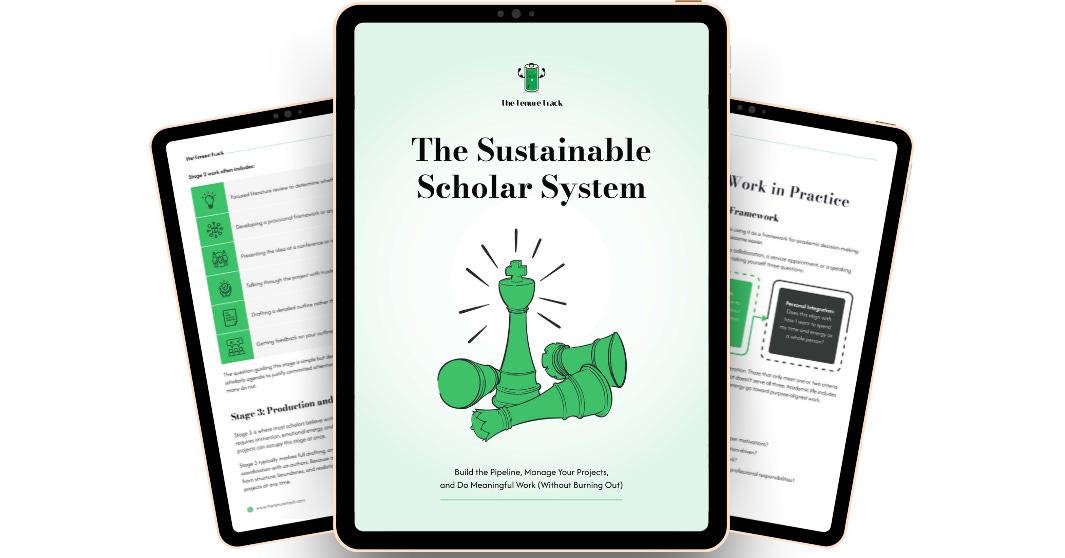
The goal was not to create another productivity system or add another thing academics had to maintain. The goal was much simpler: to create a way to make the invisible work of academic life visible or structured.
The system includes four interconnected frameworks:
A Writing Pipeline Tracker that helps you see every project in progress, identify where each piece stands, and determine the next concrete step.
A Project Portfolio Dashboard that helps you evaluate whether your commitments are actually aligned with your priorities or whether too much of your time is being consumed by work that does not move your larger goals forward.
An Energy and Focus Log that helps you understand when you do your best thinking and where your schedule may be working against you.
An Opportunity Decision Matrix that gives you a process for evaluating new invitations before automatically saying yes.
There is also a Purpose Alignment Tracker to help you regularly ask whether the work you are pursuing still reflects the scholar and person you are trying to become.
An accompanying guide walks through each framework, explains how to use the tools, and includes prompts and exercises to help you move from reflection to practice.
This system is the one I wish I had when I was sitting at my desk late on a Sunday night, staring at a stack of exams and wondering why academic success felt so difficult to sustain.
For the Next Four Weeks
I am releasing The Sustainable Scholar System at an introductory price of $47 for the next four weeks (use the discount code FOUNDING47). After that, the price will increase to the normal price.
If you are carrying more projects than you can comfortably manage, if your best ideas are sitting in a folder waiting for “next summer,” or if you are producing meaningful work while constantly feeling behind, this system was built for you.
The goal is not to help you do more.
Most academics are already doing enough.
The goal is to help you find a way of working that allows you to keep doing the work that matters most.
Because our scholarship matters.
But so do the lives we build around it.
I hope this helps you.
It definitely helped me.
Becoming Full,

P.S. As always, thank you for reading this week’s issue of The Tenure Track. If you found this article helpful, share it with a friend. If it moved you, consider supporting with a paid subscription or buying me a coffee. Together, let’s continue to build a supportive and creative academic community.
Your support helps me create content that serves fellow scholars on the path.